
On the 5th, we continued with the plank I helped with the day before. I went in a bit early to help do the spiling on the plank a second time, because it seemed like it was off yesterday. After we cut the bottom edge of the plank, there appeared to be a unpredicted bump in the curve of the cut.
After re-doing it, we found it wasn’t a mistake at all, and so we carried on working the plank.
Greenspond around 1955. Out for a row

March 4th – Planking

On my way back from the Archives and Special Collections (I had a class there for one of my Gender Studies courses), I stopped by the tech lab to see the boat and met Jerome as he was leaving the room. I didn’t expect to see anyone, so I had bought a coffee, but I was happy enough to abandon it in the office for a little while so I could help out.
Continue reading March 4th – PlankingMarch 1st – Researching at MUNFLA and a visit to the boat

On March 1st I went into MUN to do some research at MUNFLA. While I was there, I went down to the third floor of the education building to see if Jerome was in working on the boat. He wasn’t so I just admired her though the pane of glass in the door. The evening class had put on another plank.

Nicole, the Archival Assistant at MUNFLA, was providing a tour to some Folk 1000 students and she put some of the material culture collection on display for them.
These are some of the fishery related miniatures. They were donated in 1979 Crysyal King and they will be on display for viewing in the Reading Room in the near future.
February 28th – Planking

Today we carried on from the last lesson and used dividers and a rulestaff to start spiling a plank.
The evening class had already completed the sheer plank, or sheer strake/binding strake, so we worked on the plank beneath.
Continue reading February 28th – PlankingFebruary 26th – Lining off the Planks
On the 26th of February, we learned how to use a vanishing point to find where the planks will lay on each frame.
According to my notes, I wrote about the events of that day on March the 1st. I also didn’t finish writing the diary entry for that day. Over the course of the semester, I tried to record the days events either on paper, or in the Facebook album I made of the photos I have been taking. Those notes are then reproduced on here with some editing, however all my notes and materials will be available at MUNFLA in their Archives when I’m finished the course.
So, this post isn’t as detailed as the others, however, Greg Rossel does a fantastic job of explaining the vanishing point, or “The incredible diminishing device” (142) as he called it, in his book, Building Small Boats.
Continue reading February 26th – Lining off the PlanksThe Rabbet Lines

On January the 29th worked on the rabbet lines, which are lines that are cut into the backbone to accommodate the frames and planks.
The frames are what determine the shape of the boat. In order to get the right shape, you have to make room in the keel and hog to accommodate the frames. Because the boat has curves, the cut will be made at different angles, as determined by the rabbet line. To find the rabbet line, measurements have to be taken from the drawings that represent the frames. There are three different points that form the rabbet lines. In the 2019 Marcus French Rodney, the points run though the keel and the hog.
February 14th – Fitting and shaping frames
It snowed on February the 14th, which was also the beginning of midterm break, so we were down a few students.
That day, we continued work on the frames. The extra epoxy, from the lamination process, had to be removed with planers, and then the frames were cut down the centre, making two symmetrical pieces.
Continue reading February 14th – Fitting and shaping framesWhere to read David Taylor’s Masters Thesis on boat building in Winterton
David Taylor’s Masters, thesis, printed in 1980, is available at the Centre for Newfoundland Studies, in the Book Stacks of the QEII, and at MUNFLA in the reading room. It is printed in two parts.
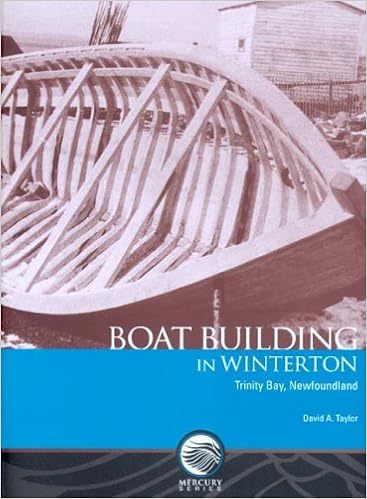
The thesis was condensed and reprinted in 2006 by the Canadian Museum of History. You can get a copy on Amazon. It comes with the lines plans to build a Rodney in the style of Marcus French.
This book is also available to borrow though Memorial Universities Library.
You can read the thesis online by downloading a PDF from the following link: Boatbuilding in Winterton : the design, construction, and use of inshore fishing boats in a Newfoundland community by David A. Taylor (1980)
Blogs and online articles, about the Wooden Boat Museum.
Blogs
- From Stem to Stern in TA Loeffler’s Adventures that Move, by TA Loeffler
- Building Wooden Boats in Winterton, Newfoundland in Contrarian by Parker Donham
In the News
- Building a dory — and life skills — in downtown St. John’s by Todd O’Brien (CBC)
- Along Newfoundland’s East Coast, creativity lurks in every corner by Tim Johnson (The Star)
Online Articles
From Downhome Magazine
- Building a Newfoundland Punt by Tobias Romaniuk
- It’s Our Heritage – Pass It On by Kim Kielley
- Floating a New Hobby – man builds first boat at 70 years old by Elizabeth Whitten
- Little Wooden Boats of Newfoundland by Tobias Romaniuk
- The Bully of Pond Head Submitted by Mary (Burry) Eveleigh of Comfort Cove-Newstead, Newfoundland
- Buying a Boat?
 Building a Traditional Newfoundland Punt